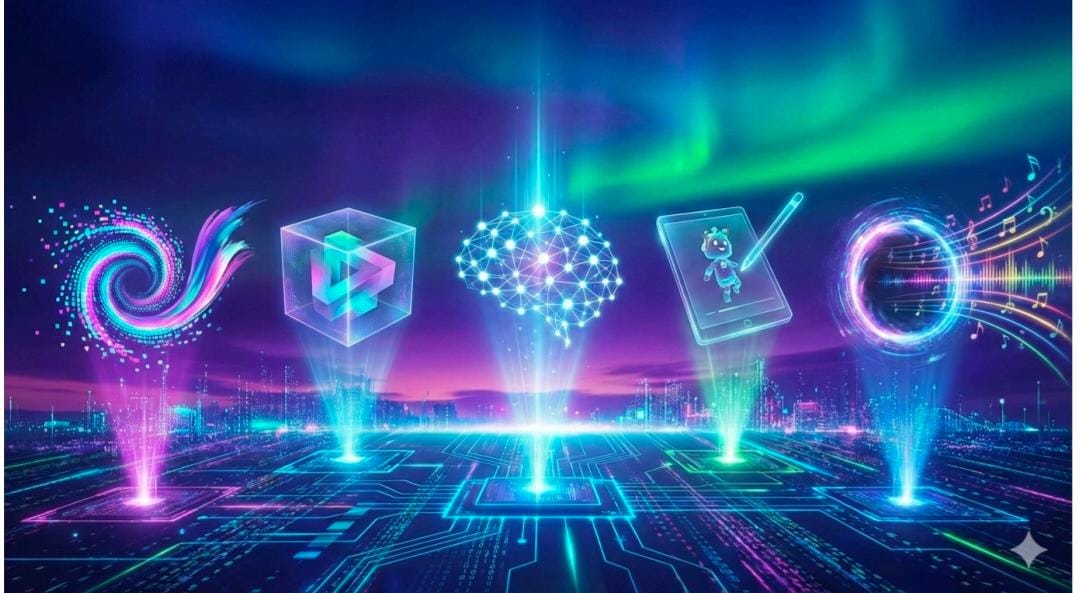
The landscape of creative expression is undergoing a seismic shift. We have moved beyond the era of static pixels and manual brushstrokes into a period where human intent merges seamlessly with algorithmic intelligence. This new age of digital art isn’t just about faster production; it is about the expansion of what is possible. From transforming a simple thought into a cinematic sequence to upscaling a rough sketch into a masterpiece of texture and light, the tools available today are redefining the very definition of an “artist.” For those navigating this brave new world, five specific platforms stand out as the pillars of this creative revolution.
1. Invideo: The Command Center for Visual Storytelling
Invideo has emerged as a cornerstone for creators who need to bridge the gap between static concepts and dynamic visual narratives. The platform has evolved far beyond basic editing, now offering a holistic environment where text prompts dictate the rhythm and aesthetics of a project. By integrating an advanced ai art generator from text into its core system, it allows creators to manifest custom imagery that perfectly aligns with their script’s mood. This capability is particularly transformative for independent creators and marketing teams who previously relied on generic stock libraries; now, every frame can be a unique piece of digital art tailored to a specific vision.
The agility of this system is further amplified by its presence on mobile devices, ensuring that the creative process is never tethered to a desk. As one of the most versatile ai video apps on the market, invideo provides a fluid transition between high-level conceptualization and on-the-go adjustments. This mobile flexibility allows users to prompt, edit, and refine their visual content from anywhere, democratizing the production of studio-quality visuals. Whether you are building a complex narrative or a quick social update, the integration of deep learning models into a portable interface makes it a vital engine for modern digital artistry.
2. Magnific AI: The Master of High-Fidelity Refinement
If the initial wave of digital art was about generation, the current wave is about perfection. Magnific AI has captured the imagination of the creative community by solving one of the most persistent hurdles in digital creation: resolution and detail. This tool functions as a sophisticated “enhancer” that does not merely stretch pixels but intelligently reimagnines them. It uses a process often described as “hallucination control,” where the engine adds intricate textures, realistic skin pores, or atmospheric depth to an image that was previously flat or low-resolution.
For digital painters and concept artists, this tool acts as a final “glaze” that brings a professional sheen to their work. An artist can take a rough, grainy output from a generative model and pass it through this engine to receive a high-definition piece fit for a gallery or a large-scale advertisement. It represents a shift from “making” to “curating and refining,” allowing artists to focus on the broad strokes of their vision while the system handles the microscopic complexities of texture and light.
3. Krea AI: The Real-Time Creative Instrument
One of the most exciting breakthroughs in recent times is the move from “prompt-and-wait” to real-time interaction. Krea AI is at the forefront of this movement, offering a workspace where the AI responds to every move of the artist’s hand in milliseconds. This is not just a tool; it is a creative partner. As an artist moves a shape on a canvas or adjusts a slider for “mood,” the generated image shifts instantly, providing a feedback loop that feels more like playing a musical instrument than operating a computer system.
This real-time capability is a game-changer for the ideation phase of digital art. Instead of hoping a text prompt captures a specific composition, an artist can “carve” the scene manually, using the AI to fill in the stylistic details as they go. This restores a sense of tactile control to the digital artist, making the process feel intentional and organic rather than random. It bridges the gap between the traditional artist’s instinct and the power of modern neural networks.
4. Midjourney: The Standard-Bearer for Digital Aesthetics
No discussion of the new age of digital art would be complete without mentioning Midjourney. It has become the gold standard for aesthetic quality in generative imagery, known for its distinct, often painterly style that avoids the “uncanny valley” of more clinical engines. Midjourney thrives on a community-driven ecosystem where artists can learn from one another’s prompts and styles, creating a massive, collective library of visual inspiration.
The breakthrough here is the platform’s deep understanding of art history, lighting, and composition. It allows an artist to invoke specific lighting styles—like “chiaroscuro” or “cinematic anamorphic”—and receive results that reflect a deep grasp of those technical concepts. As the tool continues to evolve, it has introduced features for consistent character creation and precise style-referencing, making it an indispensable asset for storyboard artists, book illustrators, and character designers who require a high degree of visual cohesion across a series of works.
5. Luma Dream Machine: The Frontier of Motion and Physics
While static imagery has reached a point of near-perfection, the next frontier is the simulation of movement. Luma Dream Machine represents a massive leap in how we create motion in digital art. Unlike earlier attempts at animating stills, this engine understands the laws of physics, ensuring that hair flows naturally, light reflects correctly off moving surfaces, and character movements have a sense of weight and purpose.
This tool is democratizing the world of high-end animation and visual effects. It allows a single digital artist to produce cinematic clips that would have previously required a full studio of animators and render farms. By providing intuitive control over camera angles and motion paths, it gives artists the power to direct scenes within a digital space, effectively turning them into cinematographers of their own AI-generated worlds.
The Evolution of the Creative Workflow
The integration of these tools into a unified workflow marks the beginning of a new era. The modern digital artist is no longer defined by their ability to manually render a shadow, but by their ability to orchestrate these powerful engines. A typical project might start with a conceptual sketch in Krea, be transformed into a high-resolution base in Midjourney, refined for microscopic detail in Magnific, and finally brought to life with cinematic motion through Luma or invideo.
This workflow is not about replacing the human element; it is about amplifying it. These platforms handle the “grunt work” of digital production, allowing the human artist to remain in the “flow state” for longer periods. The focus has shifted toward high-level decision-making: the choice of color theory, the pacing of a narrative, and the emotional resonance of a scene.
Conclusion
The “New Age of Digital Art” is characterized by a move away from static, labor-intensive processes toward a fluid, interactive, and highly intelligent creative ecosystem. Tools like invideo, Magnific, Krea, Midjourney, and Luma are not just conveniences; they are the new brushes and canvases of the twenty-first century. They allow us to communicate ideas with a speed and clarity that was previously unimaginable, turning every person with a vision into a potential creator.
As these systems continue to refine their understanding of human intent, the line between the tool and the artist will continue to blur. However, the heart of the art remains human. It is the artist who chooses which tool to use, which prompt to write, and which generated vision to share with the world. We are entering a golden age of creativity where the only limit is the scale of our own imagination.